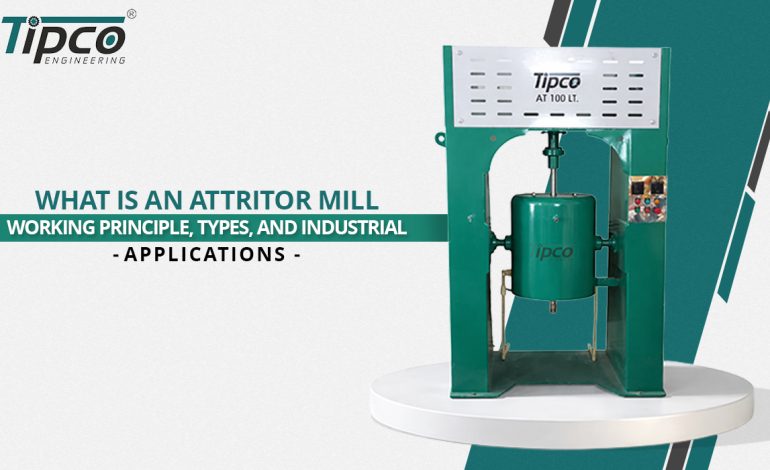

An attritor mill is essentially a high-intensity grinding device that can efficiently and swiftly decrease particle size to an incredibly small powder. Understand first what an attritor mill is. By contrast to typical ball mills, attritors use a centrally driven agitator shaft decorated with arms to stir a stationary tank housing the material slurry and grinding media. One form of mill that spins the material inside a drum is the ball mill.
Compared to its predecessors, the outraged media activity is significantly more vibrant and effective. An Attritor mill for grinding, sometimes referred to as a swirling ball mill, is a kind of milling machine used for material mixing and grinding. The manufacturing of ceramics, paints, and other materials needing fine grinding makes great use of it.
Principles of Operation
The agitated grinding principle is how attritor mills operate. The material being ground, as a set of interconnected arms or discs spin at high speeds on a grinding shaft. The grinding media includes steel balls or ceramic beads. It comes into contact with one another. The collisions produce shear and impact, and compression forces.
This, in turn, split the material into smaller pieces. The material to be ground, the grinding medium, and any dispersants or additives are typically loaded into the grinding chamber. It happens throughout the grinding operation. The required particle size and distribution can be obtained by altering the grinding time and speed.
An Attritor Mill and Its Components
The main pieces of an attritor mill are its grinding chamber, agitator, shaft, motor, and control system. An Industrial attritor mill is a type of milling machine that can grind and mix materials. This milling machine is efficient and may be used for a range of jobs.
They offer various benefits over other mill types, including more efficient grinding, more control over particle size and distribution, and more homogeneous mixing. An attritor mill could be the right milling solution for your needs if you need it to work with a wide variety of materials and generate high-quality results.
Attritor Mills: A Primordial Overview
Because of their user-friendly and adaptable design, the S Series of Batch Attritors is perfect for both dry and wet applications requiring the grinding of small to medium amounts of material. They enable inspections to be carried out during the process.
When compared to batch processing, the results are more consistent and homogeneous since the material is cycled through a tank before being processed using circulation attritors.
The Continuous Attritors mills are made for high-volume production and offer continuous feeding and discharge all the way through the manufacturing process.
High-speed attritors are appropriate for both demanding and specialised applications because of their enhanced grinding speed, which enables the quick reduction of particle size.
Dry grinding was taken into consideration when designing the SD Series of dry grind attritors, which efficiently reduce particle size without the use of liquids.
Main Uses in Industry: Paint, Ink, and Pigments:
For generating uniformly coloured, high-quality paints, printing inks, and coatings, the Tipco Engineering Attritor mill machine is used to crush and disperse pigments in liquids.
Metal powders can be mechanically alloyed with ceramics and oxides to form ferrite, magnetic materials, and ultra-fine ceramic powders like alumina and silica.
For precision particle size distribution, this milling process is suitable for specialist chemical products, agricultural flowables, and APIs in the pharmaceutical and chemical industries.
In the food and confectionery industry, this technique is used to grind materials and process chocolate and other high-viscosity products.
These minerals and materials are used in the production of micron-sized goods, as well as in the grinding of ores, sulphur, and plastic fillers.
The technique of micronising unsorted trash into Refuse-Derived Fuel (RDF) is used in the environmental waste management sector.
Conclusion
Mechanical alloying and the fabrication of premium technical ceramics are two examples of applications of Tipco Engineering Attritor mill machines that benefit considerably from their utilisation. Both require high-energy materials to be processed quickly.
Also read: Premium Mill Machine for Efficient Industrial Production